 Dexon Technology
There is no room for error in pipeline inspections – and there is even less room when a pipeline sits 40 meters underwater.
Recently, Dexon completed ultrasonic in-line inspections on two subsea crude oil lines – 52-in. and 42-in. in diameter. ) Engineering Before Execution
Engineering Before Execution
Prior to launch, the design team reviewed previous subsea launches to improve on the current tool, followed by extensive on-site validation.
Nine separate push-through tests were performed using verification spools to optimize, in partnership with the operator, calibration of the rotary inspection head.
These trials ensured correct sensor response, stable coupling, and accurate sizing under expected operating conditions.
The tool was also modified and tested for saltwater exposure to verify sealing integrity and electronic stability in a marine environment. ) Subsea Deployment
Subsea Deployment
Over three days, a team of divers installed a custom launcher 40 meters below sea level at the PLEM, disconnecting the pipe from the risers and installing a meter-long launcher.
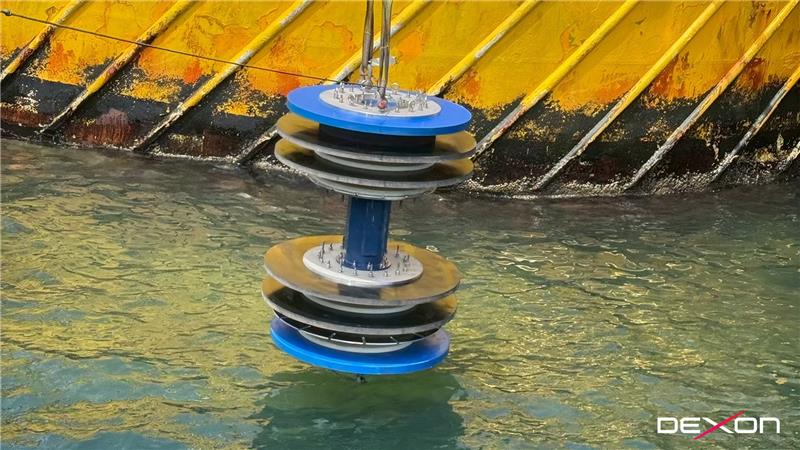
The Ultrasonic Testing Rotary (UT-R) Owls were lowered into the water, where they were received, brought online, and inserted into the launcher. The operator’s dive team, trained by Dexon engineers, supported final checks and launch procedures.
Once released, the tools navigated the full lengths of the subsea pipelines before surfacing at an onshore refinery reception point.
Results
Both inspections were successes, delivering complete data coverage across the entire length of each line.
For large-diameter subsea launches, success depends on collaboration and preparation: mechanical validation, ultrasonic calibration, proper training of divers, and a carefully choreographed execution offshore.
---
If you have a difficult-to-inspect line – onshore or off – reach out to Dexon to see how our fleet of ILI tools can support your integrity programs.