 Dexon Technology
One of the stranger truths of ultrasonic in-line inspection is that a larger sensor can sometimes produce less reliable data.
At first glance, bigger transducers may seem better — they generate more energy and can perform well in thicker materials, but may actually perform worse in other pipeline configurations.
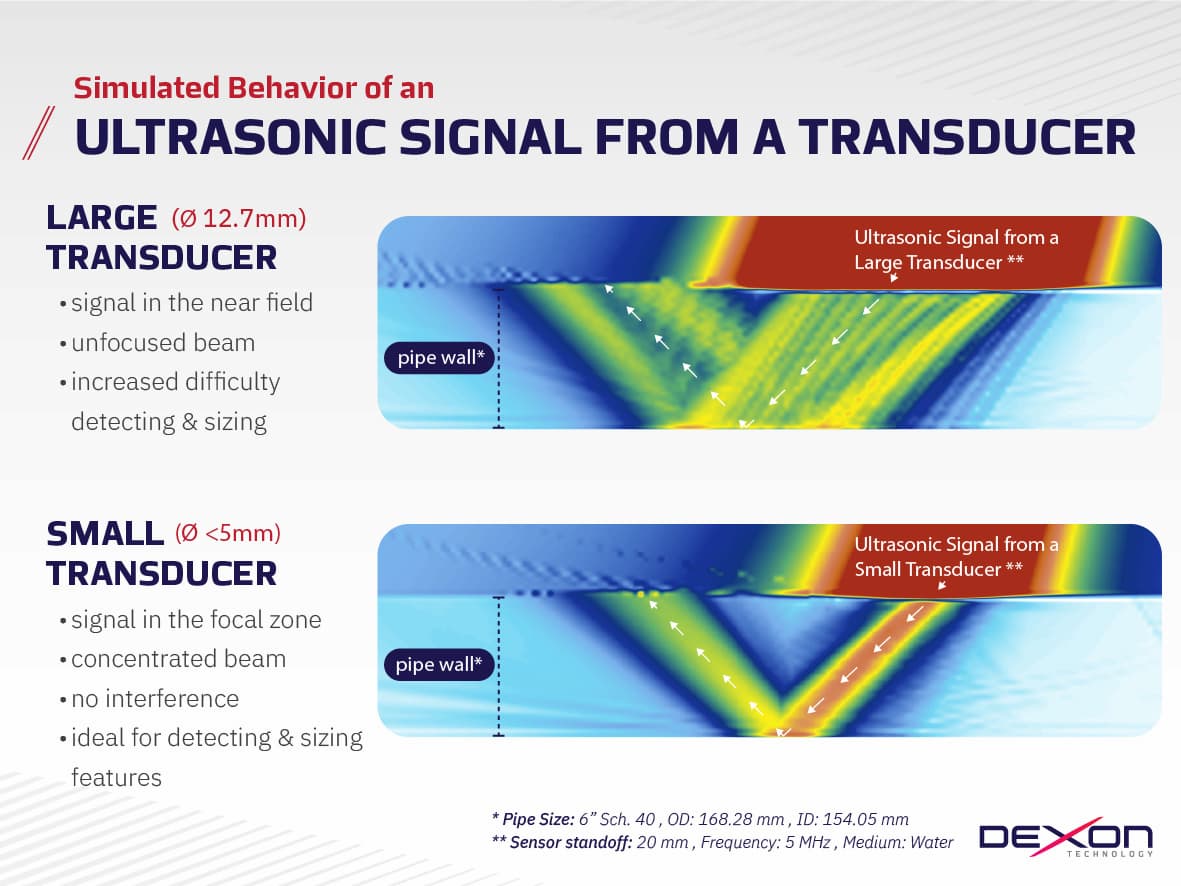
Every transducer produces a near field – a chaotic zone immediately in front of the sensor where sound waves interfere with one another. Inside this zone, signal amplitudes can vary dramatically, making measurements less reliable.
Additionally, the near field can make it difficult to accurately determine the size and length of cracks or corrosion smaller than the beam width.
Smaller sensors produce a much shorter near field. In some high-resolution UT tools, a sub-5-mm transducer reaches its focal zone only 20 mm from the pipe wall, enabling stable, repeatable measurements. Larger sensors may still be in their near field (and less accurate) long after the sound has encountered a defect.
The image below shows how the UT signal behaves based on large vs. small transducers placed at the same distance from the pipewall.
But if large transducers need more distance from the wall, why don’t engineers simply move the transducers further away?
The answer: space. In-line inspection tools, particularly in the small-to-medium range (3- to 16-in.), have very little space to accommodate all the required electronics.
Moving the transducers further from the pipe wall would shrink the tool's body—and create more challenges for engineers already struggling to fit everything into the available space.
This design constraint is one reason why a UT tool designed for a 6-inch steel pipeline may look very different from one used to inspect a thick-walled HDPE slurry line.
In ultrasonic inspection, bigger sensors and greater power do not always produce better data.
Sometimes, the best measurements come from making the sensor smaller.
At Dexon, we are proud to have the ability to customize any transducer size in our in-house research & development department.