 Dexon Technology
Cross-training is not only valuable for Cristiano Ronaldo or Stephen Curry. In pipeline inspection, exposing specialists to different technologies sharpens the fundamental skills they bring back to their core discipline and makes them more effective in the field.
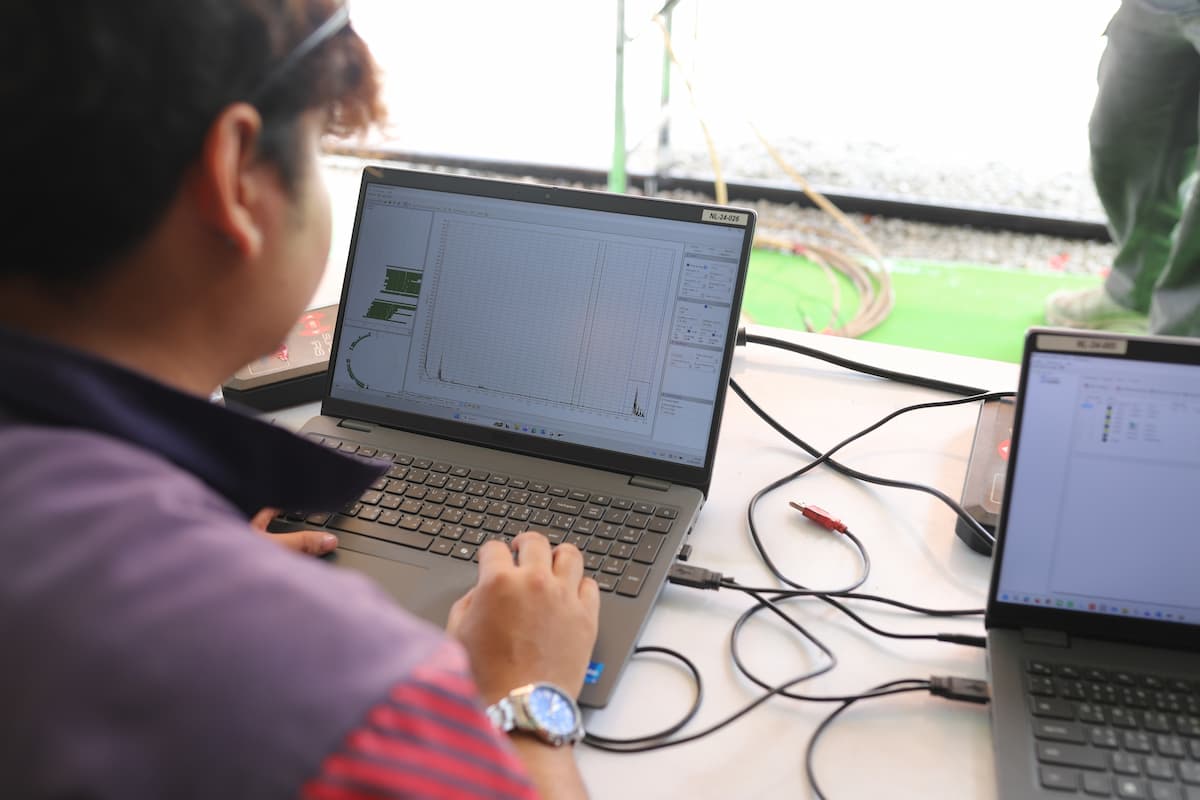
Recently, Dexon’s ILI inspectors completed training on our proprietary Internal Rotary Inspection System (IRIS), a technology used to inspect heat exchangers, boilers, and other small-diameter tubing. :quality(80)) IRIS works by flooding the tube with water and directing an ultrasonic beam onto a rapidly rotating mirror. As the probe travels through the tube, the reflected beam scans the full circumference, measuring the distance between the inner and outer surfaces to determine remaining wall thickness.
IRIS works by flooding the tube with water and directing an ultrasonic beam onto a rapidly rotating mirror. As the probe travels through the tube, the reflected beam scans the full circumference, measuring the distance between the inner and outer surfaces to determine remaining wall thickness.
:quality(80)) At first glance, IRIS and pipeline ILI operate in very different environments. For inspectors, however, there is considerable crossover.
At first glance, IRIS and pipeline ILI operate in very different environments. For inspectors, however, there is considerable crossover.
Both demand a strong understanding of ultrasonic propagation, coupling, calibration, wall-thickness measurement, signal quality, defect characterization, and data interpretation.
The equipment may change—from a tethered IRIS probe inside a heat exchanger tube to an ultrasonic ILI tool traveling through a pipeline—but much of the underlying physics remains the same.
That cross-training has practical benefits for operators.
Inspectors develop a deeper understanding of why an inspection tool is behaving the way it is, not simply how to operate a particular tool. In the field, that can translate to better troubleshooting, faster recognition of data-quality issues, stronger judgment when conditions differ from plan, and a lower risk of repeat mobilizations.
:quality(80)) For Dexon, building broader technical expertise helps strengthen the quality of every inspection we deliver.
For Dexon, building broader technical expertise helps strengthen the quality of every inspection we deliver.