Why Crack Sizing Tolerances Matter for In-Line Inspections of Pipelines
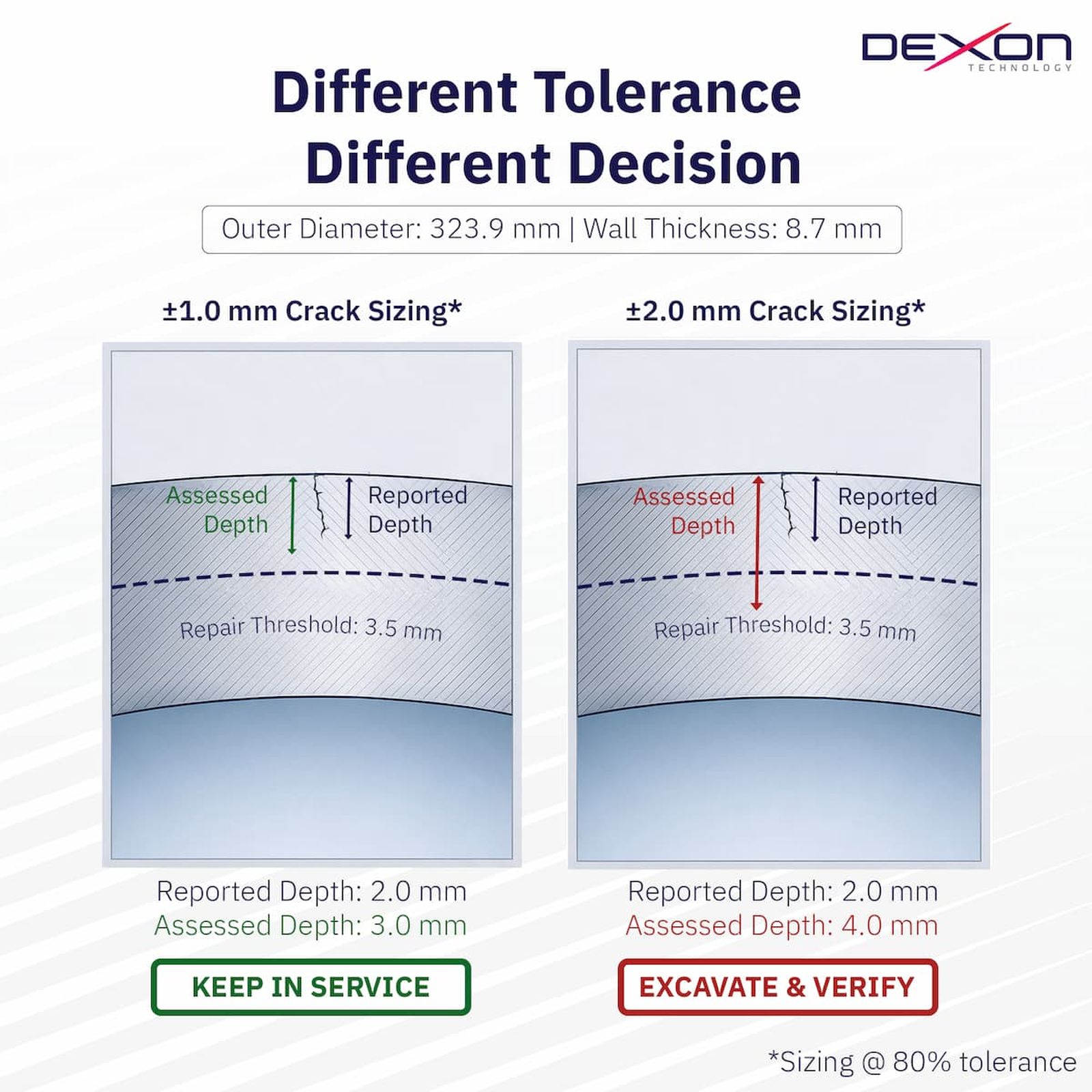
When an in-line inspection (ILI) reports a crack, the operator has a decision to make. Dig and repair? Lower the pressure? Re-inspect sooner, or with a different technology? Or keep the line running as it is?
That call often comes down to a single millimeter, and how much the reported depth can be trusted.
What a Sizing Tolerance Tells You
Every measurement has a margin of error. In crack ILI, it’s called the sizing tolerance: how much deeper or shallower the actual crack is expected to be than the reported one.
A tolerance always comes with a certainty level. “±1.0 mm at 80% certainty” means at least 8 in 10 cracks fall within 1.0 mm of their reported depth. The rest can fall outside that band.
To stay on the safe side, operators commonly add the tolerance to the reported depth and assess the crack at that size. They then weigh it against operating conditions, regulations and what’s nearby. A crack under a farmer’s field isn’t treated the same as one near a school.
Same crack, different decision
An Example of Sizing in Action
Take a 12-inch pipeline with an 8.7 mm wall and a repair threshold of 40% wall thickness (about 3.5 mm). An ILI run reports a crack 2.0 mm deep.
Here’s how two tools, quoted at the same certainty level, compare:
±1.0 mm tool: 2.0 + 1.0 = 3.0 mm (34% of the wall). Below the threshold, so no dig for now. The line stays in service and the crack is monitored.
±2.0 mm tool: 2.0 + 2.0 = 4.0 mm (46% of the wall). Above the threshold, so the operator must excavate and repair, or run at reduced pressure until they can. That means lost throughput.
That 1.0 mm, about the thickness of a heavy guitar pick, decides whether a crew goes out or the line keeps running at full pressure.
The wider tolerance also says little about shallow cracks. At ±2.0 mm, a 2.0 mm reading could mean anything from 0 to 4 mm.
Same crack. Different tolerances. Different decision.
Why Depth Matters So Much
Engineers also weigh crack length, operating pressure and material toughness. But depth is the most sensitive input. In crack-growth and fracture calculations, a 1 mm difference in depth can shift a pipe’s predicted remaining life by years.
The costs aren’t equal either. An unnecessary dig has a known price, often more than the inspection itself. An undersized crack has no upper limit. Tight tolerances reduce both risks, and across dozens or hundreds of pipelines, the savings add up.
The Takeaway
A tighter tolerance isn’t a vanity metric for inspectors and operators. It means fewer unnecessary digs, earlier action on the cracks that matter, and decisions operators can defend.
When operators compare crack inspection tools, ask two questions: at what certainty is the tolerance quoted, and how was it proven in the field?
For technical discussions or inspection planning support: